
Concept-to-showroom road becoming shorter journey
Cars at show no longer there just for 'wow' factor
1/15/2012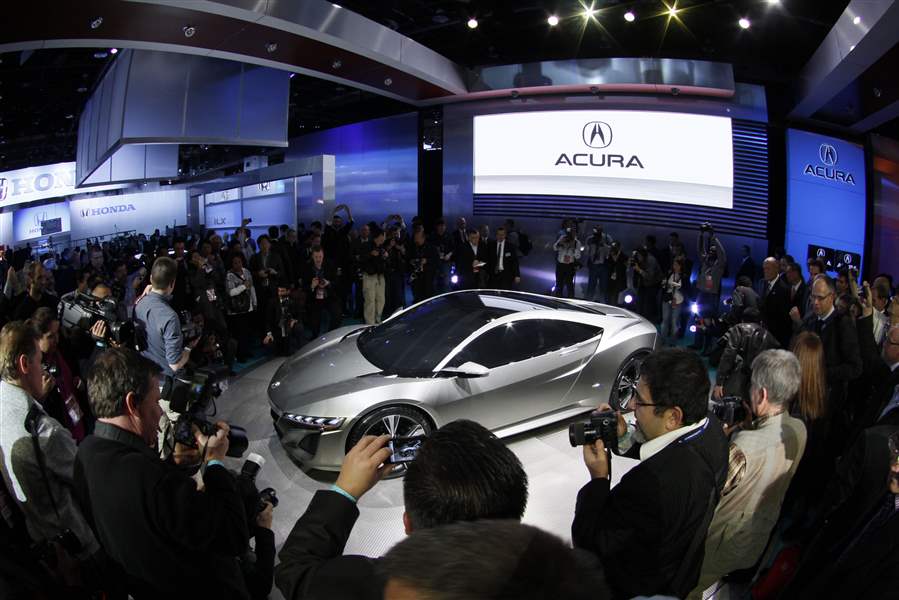
The Acura NSX, which is to be built in Ohio, starting about three years from now, is expected to be nearly identical to the one unveiled at the auto show in Detroit.
the blade/andy morrison
Buy This Image
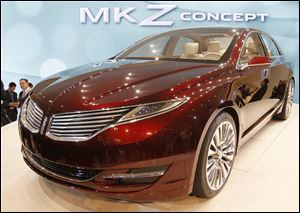
Lincoln hopes its MKZ concept car is a big step in the reinvention of their brand. Designer Solomon Song said the firm is 'trying to bring the luxury back where it's exclusive, mysterious, and elegant.'
DETROIT -- Lincoln says the angular side view mirrors on its MKZ sedan concept feature a "structural pedestal design." They're also very small.
Perhaps the company would rather not see its recent past as it drives toward its future.
Sales at Ford Motor Co.'s luxury division have been stagnant since 2009, and many have directed mystified criticism over the recent styling of its vehicles. Meanwhile, Ford sales have increased 42 percent from 2009 and rival brand Cadillac has been revamping its lineup and outsold Lincoln by some 66,000 vehicles last year.
STORY: Eye candy to fuel efficiency drive 2012 Detroit Auto Show
Lincoln officials say their brand needs to be reinvented, and they're pointing to the MKZ concept as proof they're on their way to doing just that.
"In-your-face luxury is so common these days you can't get away from it," Lincoln designer Solomon Song said in an interview on the show floor of the 2012 North American International Auto Show, where the car was unveiled Tuesday.
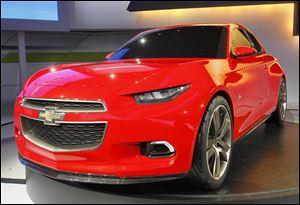
The Chevy Code 130R, above, along with the True 140S, is a world premiere. Chevy wants feedback, so the company has paired the cars with interactive displays in the hopes that show-goers will leave that feedback.
"What we're trying to do is bring the luxury back where it's exclusive, mysterious, and elegant."
Analysts expect the next generation MKZ to be very close to the concept, including the understated mirrors.
RELATED STORY: Politicians' visibility increasing at Detroit auto show
It used to be that concept cars were lavish and wild. Now most automakers are tempering their imaginations, keeping concepts close to the cars that actually will be built.
Of the 18 cars unveiled as concepts during the two-day media preview last week, at least eight are expected to be very close to the production version. Several others have production potential or exhibit technology likely to eventually show up in production models, if not the specific car being showcased.
Only a handful, such as the Lexus LF-LC sports car and the Smart-For-Us miniature pickup, seem unlikely to be built or need some serious tweaking.
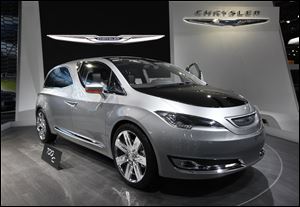
The Chrysler 700c minivan concept surprised even CEO Sergio Marchionne, who said he'd like to have a final concept early in this year's second quarter.
"[Automakers] used to be after the wow factor of pulling in the consumer into their booth at the auto show, or pulling in journalists, or showing how futuristic and modern their thinking was. I think they started to see they just disappointed the consumer then when the real thing comes out and it wasn't anything close to what they were talking about," said Rebecca Lindland, a senior analyst with IHS Automotive.
With the time it takes to develop an all-new vehicle, automakers always have to be gazing far into the future. Concept cars can be an important canvas for designers to try new ideas and float them with the public.
That's what Chevrolet is doing. The American automaker known for Corvettes and Camaros brought three concepts to Detroit. Two, the Code 130R and True 140S, were world premieres. Chevy says the cars are the result of research into the millennial generation, those born between the 1980s through 1990s, a group the company says is 80 million strong. The firm has paired the cars with interactive displays that allow show-goers to leave feedback on what they like and what they don't.
"We know they want to engage in the conversation," General Motors spokesman Michelle Bunker said. "They want to be part of the conversation at the brand level of the vehicles. That's why Chevrolet is doing that. We know they want to be heard."
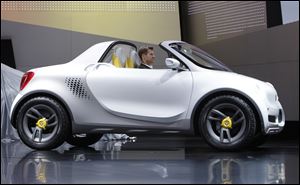
The Smart-For-Us miniature pickup is one of the concept cars at the show whose maker says it might not be built. Concept cars used to go for the 'wow' factor, experts say, but when they arrived in showrooms, the public was disappointed.
Though GM hasn't slated either car for production, it's not a huge stretch to see one being given the green light. The Code, a muscle-car inspired traditional coupe, is a rear-wheel-drive based on the same platform as the new Cadillac ATS. The Tru, with sharper-lined exotic styling, is based on the front-wheel-drive platform that underpins the Chevy Volt and Chevy Cruze.
"We want validation that the philosophy and the platform strategy behind the cars is correct," said Joe Baker, a senior GM designer who drew up the Code. "We're pretty certain it is; it's what we've been told they want. Now we need to show them in execution and get some feedback."
Ms. Lindland said she thinks GM will build something similar to the concepts within five to seven years.
"Will either vehicle look exactly the same? It's not likely. But I think we'll see familiarity," she said.
Acura's NSX supercar -- which is to be built in Ohio, starting about three years from now -- is expected to be nearly identical to the concept shown in Detroit.
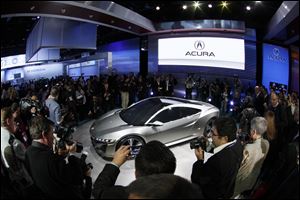
The Acura NSX, which is to be built in Ohio, starting about three years from now, is expected to be nearly identical to the one unveiled at the auto show in Detroit.
"That is the NSX. This basic styling, that basic powertrain is what we're going to bring to market," Acura spokesman Gary Robinson said.
Honda's luxury arm had a huge hit with the original NSX, which was released in the United States in 1991. The company quit selling the mid-engine car in 2005. The new model will also be midengine and rear-wheel-drive, but use hybrid technology to drive the front wheels.
That technology is expected to be tweaked for the next edition of Acura's flagship RL sedan.
And there are always surprises with concepts -- sometimes even for the executives of the companies from which they come.
"I don't know what it's called," Chrysler chief executive officer Sergio Marchionne said Monday to a reporter who asked about the unexpected minivan concept that was on the show floor. "Is that what we're calling it? We're calling it the 700C? It was nameless yesterday. ... Neat."
Mr. Marchionne doesn't see much growth potential for the segment, but still says Chrysler needs to completely rethink its minivan offering.
"The 700C, which is a proud example of what the design office can do, is one way which we've been trying to peel away the skin of the onion," he said.
How much of the styling -- which includes a large and rakish b-pillar and smooth, rounded rear -- might make it into a production model isn't known, but if Mr. Marchionne has his way, it will be soon.
He told journalists he'd like to have a final concept early in this year's second quarter and perhaps have a new model by next year.
Contact Tyrel Linkhorn at: tlinkhorn@theblade.com or 419-724-6134.