
U.S. auto-parts sector under siege by China
Subsidies blamed for trade deficit
2/2/2012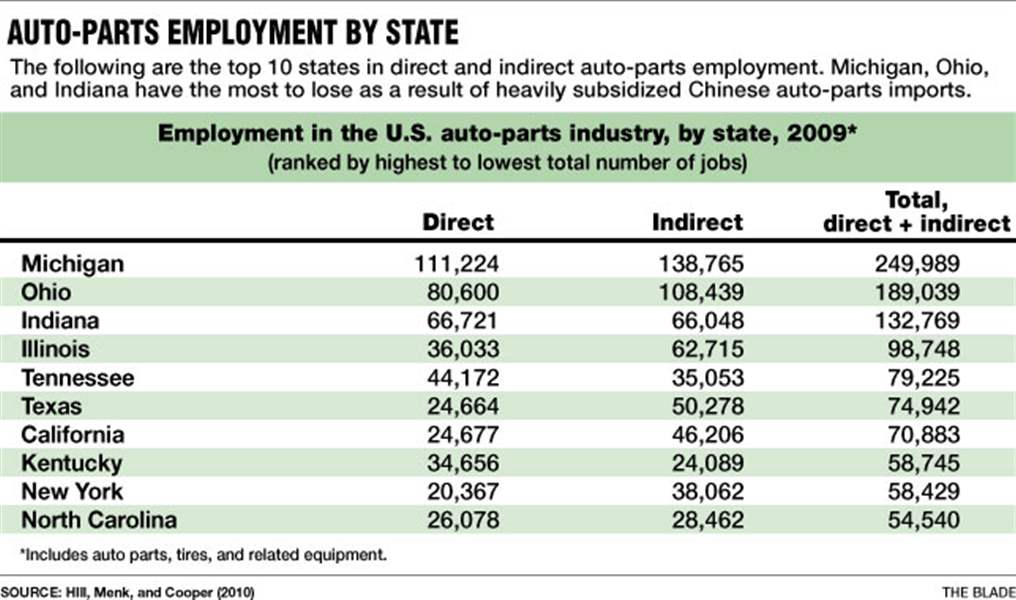
The auto-parts manufacturing industry, which employs thousands of men and women in northwest Ohio, is facing a grave threat from China, according to two new studies.
The studies by the Economic Policy Institute and by the Washington labor law firm of Stewart and Stewart found that as auto manufacturing zoomed upward, auto-parts manufacturing has not kept pace, and the studies pinpoint Chinese incursion into the parts business as the reason.
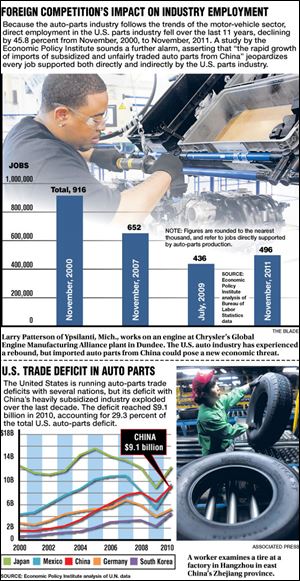
Since the deepest point of the recession in 2009, the U.S. auto-parts industry has regained only 60,000 jobs, an increase of 13.8 percent. From 2000 to 2011, the United States lost more than 400,000 direct jobs in auto parts, according to the EPI study, which was released this week.
Michigan and Ohio are the nation's leading auto-parts manufacturing states, with Michigan totaling 249,989 auto-parts-related jobs, or about 6.5 percent of the state's total employment, while Ohio has 189,039 such jobs, or 3.7 percent of the state's total employment.
EPI is a nonprofit, nonpartisan Washington think tank created in 1986. One of its focuses is on "liberal economic policies," according to its Web site, but its primary field of study is the economic conditions of low and middle-income Americans. Its staff includes seven PhD-level economists, with the majority of its funding coming from foundations, 53 percent, and labor unions, 29 percent.
The EPI's report, "Jobs in the U.S. auto parts industry are at risk due to subsidized and unfairly traded Chinese auto parts," by Robert E. Scott and Hilary Wething, says Chinese auto-parts exports increased more than 900 percent from 2000 to 2010, largely because the Chinese central and local governments heavily subsidize that country's auto-parts industry.
According to the report, the Chinese government provided $27.5 billion in subsidies between 2001 and 2010. Many of these subsidies were prohibited by the World Trade Organization. Plus, Chinese auto-parts makers benefit from China's illegal currency manipulation, which reduces the cost of Chinese auto parts by an additional 25 to 30 percent, the studies concluded.
The studies were being trumpeted this week by United Steelworkers President Leo Gerard.
"China is cheating unmercifully in this sector, and we are saying to China -- and asking our government to stand up to China and say -- 'Enough is enough.' It is time to enforce our trade policies," Mr. Gerard said.
President Obama raised the alarm in his State of the Union speech Jan. 24. He said his administration has brought nearly twice as many trade cases against China as the Bush administration did. And he announced creation of a Trade Enforcement Unit.
The concern is not a new one, and it's one that crosses party lines, although the voices in support of organized labor tend to be the loudest.
In December, Ohio Sens. Rob Portman (R.) and Sherrod Brown (D.) sent a letter to the Obama Administration saying that new Chinese tariffs on American automobile imports "are completely unwarranted and unjustified" and hurt Ohio manufacturers.
"Since the U.S. established permanent normal trade relations with China and China joined the World Trade Organization in 2001, the United States' deficit with China on auto-parts trade has increased nearly tenfold, from $1.03 billion in 2001 to $9.95 billion in 2011," Senator Brown said.
"Without an aggressive approach to addressing the Chinese subsidies outlined in this new report, this unlevel playing field could jeopardize hundreds of thousands of jobs," he said.
Senator Brown said it's tough to get American manufacturers to speak out because many have plants in China or sell products in China, and they fear retaliation by the government there.
'China is cheating'
U.S. Rep. Marcy Kaptur (D., Toledo) was recently appointed by House Minority Leader Nancy Pelosi to the Congressional Executive Commission on China. Miss Kaptur said China doesn't play by the rules and that was why she opposed normalized trade relations with China in 1998.
"China is cheating. They're cheating in autos, in auto parts, and steel, and they're not abiding by world trade laws. A Jeep Cherokee in China costs $85,000 -- three times as much as in the United States. They put on all kinds of tariffs, anti-dumping tariffs, and 59 kinds of regulations that make our products uncompetitive," Miss Kaptur said.
One of her proposed solutions is to create a more professional corps of trade negotiators for the United States who would have the same status and tenure as the diplomatic corps.
She has introduced House Resolution 1717 to require the President to take action to reduce the trade deficit with any country where the United States has had a trade deficit of $10 billion or more for three consecutive years. Miss Kaptur noted that the bill isn't focused just on China.
Christine Mangi, a spokesman for Senator Portman, said he "has a long record of standing up for Ohio manufacturers against unfair trade practices and believes the Obama Administration should label China as a currency manipulator."
Samuel J. Wurzelbacher, also known as "Joe the Plumber," who is running for the 9th Congressional District seat now held by Miss Kaptur, said he'd vote to abolish trade agreements that cost Americans their jobs.
"That's one of the things I want to look at, trade agreements that have hurt the American worker," Mr. Wurzelbacher said. He said he believes in free trade, up to a point.
"Our job as Americans is not to go out and build other economies at the expense of the American people," he said.
A negative effect
Angela Zimmann of Springfield Township, a Democrat running for the 5th Congressional District seat, said she is "completely" on the side of American manufacturing and said U.S. policy is far too lax in allowing cheap foreign products to undercut American-made products and American jobs.
"The U.S. government has to put a stop to this unsustainable manipulation of currency. The government [of China] is subsidizing these auto-parts manufacturers and it's a false system. In the meantime people are going to lose jobs and it's going to have a negative effect on our economy," said Ms. Zimmann, a Lutheran minister and university English instructor. "We should not allow products in that are not in compliance with trade laws and allow them to sell them at lower prices -- thereby diminishing our ability to make products here."
Her opponent, incumbent U.S. Rep. Bob Latta (R., Bowling Green) refused requests from The Blade for an interview on this subject. Mr. Latta's district has one of the highest concentrations of manufacturing in Ohio and in the country and has suffered greatly in manufacturing job losses.
Toledo Mayor Mike Bell, who has made three trips to China as mayor and has encouraged Chinese investment in the city, said he leaves the issue of trade policy to people higher up than the mayor of Toledo. He said he is not worried about the possibility that the Chinese investors who bought into Toledo's Marina District and The Docks restaurant complex may have directly or indirectly benefited by China's trade imbalance with the United States.
"In fact, that hasn't been a thought that's crossed my mind. All I've been trying to do, and I think all they've at least tried to do, is figure out how we can make investments in Toledo and try to make Toledo move forward, and northwest Ohio," Mayor Bell said Wednesday. "All I know is that we have a Chrysler plant that's getting ready to add on about 1,100 people, a GM plant adding people, so whatever the issue is it doesn't seem to be affecting business right here in Toledo," Mr. Bell said.
Gov. John Kasich's spokesman, Rob Nichols, said the governor "is focused on what we can to do move the needle and ensure that Ohio workers can succeed. With a level playing field, Ohio's workers can beat anybody making anything, anywhere, and the administration is committed to ensuring that is the case."
He said Mr. Kasich criticized Chinese currency manipulation and unfair trade practices directly to a Chinese delegation he met with after he was elected in 2010, and urged them to invest in Ohio to win over Americans.
China is one of five countries with which the United States has a big trade deficit. According to EPI, U.S. imports of auto parts from China and South Korea have grown more over the past three years than auto-parts imports from any other country.
Between the last business cycle peak in 2007 and 2010, China's share gained 5.8 percentage points, and South Korea's gained 4.5 percentage points. The shares of Japan, Mexico, and Germany declined.
16,800 jobs locally
According to data from the Ohio Department of Development, there are approximately 16,800 auto-parts or auto-parts related jobs in Lucas, Hancock, Defiance, Allen, and Erie Counties -- which are the five northwest Ohio counties with the highest concentration of auto-parts-industry employment.
There are two Chinese-owned auto-parts makers in Ohio, including one in Williams County.
Powers & Sons LLC, of Montpelier, a manufacturing operation that makes steering linkage and suspension products, since 2005 has been a subsidiary of Wanxiang America Corp., which itself is a subsidiary of Wangxiang Group, a conglomerate partially owned by the Xiashan municipal government in China.
According to the Economic Policy Institute report, Wanxiang America, which makes bumpers, bearings, joints, and transmission parts for GM, Ford, Chrysler, and Toyota, has aggressively pursued mergers and acquisitions with the intent of transferring technology back to China. Since 1994, Wanxiang America has acquired more than 20 American auto-parts firms in Illinois, Michigan, Ohio, and Missouri, including a unit of Dana Holding Corp. when the Maumee-based firm was in bankruptcy in 2007.
'Billion-dollar question'
Kim Hill, associate director of research at the Center for Automotive Research in Ann Arbor, acknowledges Chinese subsidies are an issue, but said it is difficult to pin down just how great of an effect that might ultimately have on American jobs.
"That's probably the billion-dollar question," he said.
As China's own appetite for cars -- and, by extension, car parts -- grows, some of those subsidized goods will stay in China. It's a matter of looking at how many companies have enough capacity to both supply their own market and supply the world market.
"I can't really put my finger on what the amount might be," Mr. Hill said.
Mr. Hill also sees some positives in China, especially in the country's rising wages.
Increased costs might make it less attractive for American companies to set up shop there.
"The cost of things are going up in China," Mr. Hill said. "It's not as appealing for a parts supplier that wants to supply back to North America to be there, which is good news for us here in the United States and Canada."
On the whole, Mr. Hill said the Center for Automotive Research is seeing positive signs in the United States' auto-parts manufacturing sector.
Though the recession hit suppliers hard, prior to the economic downturn there was almost too much production capacity in some areas. The downturn forced both the industry as a whole and individual companies to be more lean.
"The ones that that's happened to, that have survived and are now on the upswing, they're doing really well," Mr. Hill said. "A lot of suppliers are at full capacity, running two or three shifts at their facilities."
One of the largest issues he sees is how suppliers deal with the increasing domestic auto production. In addition to low access to capital, companies will have to carefully walk the line between meeting production and overreaching, as some had done in the past.
35 percent tariff
In 2009 a 35 percent tariff was placed on all tires manufactured in China and imported to the United States, regardless of whether the tires were made by a Chinese company or American company. That tariff dropped to 30 percent in 2010 and 25 percent in 2011. It is set to expire in September.
Analysts have said some of the slack that was created in Chinese production shifted to other Asian countries, but they expect an industry shift back to Chinese production and potentially a decrease in tire prices in the Untied States.
Ray Wood, president of United Auto Workers Local 14 at the GM Toledo Transmission plant on Alexis Road, said, "We're always concerned about the outsourcing of jobs. There's an effort to take jobs away from Americans and put them in places like China.
"There are trade laws that are not in our favor, and they won't be in our favor. It has to be addressed on the highest level of government, and there have to be things put in place to put the playing field level," Mr. Wood said.
Staff writers Jon Chavez and Tyrel Linkhorn contributed to this report.
Contact Tom Troy at tomtroy@theblade.com or 419-724-6058.