
Mobile payments dream is not that far off
1/15/2012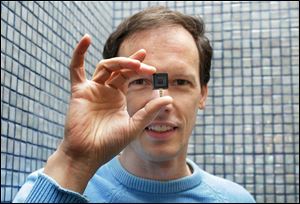
Jim McKelvey of the Third Degree Glass Factory shows off the Square, a new electronic-payment system developed by Twitter founder Jack Dorsey. The two-year-old firm has shipped more than 800,000 card readers and is now processing $2 billion in payments annually.
ST. LOUIS -- Wallets may soon be going the way of typewriters, pay phones, and videocassette recorders.
Oh, they'll still be a great place to carry photos, receipts, and odd slips of paper, but technology forecasters say we'll soon be reaching for cell phones when it's time to pay or be paid.
It's a dream that Kevin Stock is ready to live.
For nearly a year, Mr. Stock of St. Louis has been carrying around a small white plastic device he can attach to his phone at a moment's notice, creating his very own credit card terminal.
All he needs is someone willing to play along.
"I've looked for opportunities, for sure," Mr. Stock said. "But I haven't been too successful."
So far, the only taker has been his roommate. Once a month they tally up their bills, and Mr. Stock collects what he is owed through a swipe of his roommate's credit card.
And while Mr. Stock has been able to travel no further down the mobile-payment path, industry experts say it's only a matter of time -- most say it's several years out -- before we witness a radical shift in the way we exchange cash.
"I don't think it's going to go away overnight or in the next year. But mobile payments is where it's headed," said Trevor Dryer, head of product management, mobile payments, and point-of-sale for financial software maker Intuit.
Already, the financial sector is crawling with companies hoping to carve out a piece of a market that sees billions upon billions of dollars changing hands every year in the form of cash.
Much of that exchanging is done by choice, with some people simply preferring to deal in cash or checks. But there's also the fact that small businesses often find it too expensive to maintain a merchant account -- required to accept credit-card payments.
Getting around that was the inspiration behind the Square device carried by Mr. Stock.
Square, whose founders include Twitter inventor Jack Dorsey, offers credit-card processing services to pretty much anyone with the right smart phone -- most iPhones and Android-based phones.
The service is easy to use. An application links your phone and bank account, while the small card reader (the company gives them away) plugs into the earplug jack.
From there, you just need someone willing to hand you a credit card and sign the screen with their finger. A day or so later, the money shows up in your bank, minus a 2.75 percent fee.
The two-year-old firm has shipped more than 800,000 card readers and is now processing $2 billion in payments annually. But while that sounds like a lot of money, keep in mind that the nation rings up $2 trillion annually in credit-card charges.
Square is proving popular with a wide range of users, including musicians, massage therapists, restaurants, and craft fair vendors.
"Right now, there are 26 million small businesses [in the nation] that only accept cash. It's a huge market," said spokesman Lindsay Wiese.
Until September, that market included St. Louis Osuwa Taiko, a traditional Japanese drum group that now uses Square a couple of times a month to sell CDs, T-shirts, and other souvenirs after shows.
So far, it's tough to say how much of a boost they're getting from the device. But Junsei Ito, the group's treasurer, said they made 20 credit-card sales during a three-day Japanese festival over Labor Day Weekend.
"It seems like people buy more," Mr. Ito said. "They don't tend to carry a lot of cash these days. And they don't carry checks, either."
Similar to Square is Intuit's GoPayment system, which also uses a card reader to send money either to a bank account or a prepaid credit card. Intuit's mobile division is processing some $5 billion a year in credit card charges, said Mr. Dryer, the company's mobile payments chief.
And while it started as a way to offer contractors, plumbers, and electricians an easy way to take credit cards, the company loves to point out that Girl Scouts use the devices while hawking their cookies door to door.
"They are probably using their parents' phones," Mr. Dryer said. "But it's a testament to how simple this product is that 9-year-old girls are using it."
Other systems have looked for ways to remove the physical credit card from the equation. Among them are those using what's known as near field communication, or NFC.
Basically, it lets two devices exchange money when they come into contact with each other.
The technology is at the heart of MasterCard's PayPass system, in which users tap their credit cards against a PayPass terminal to complete a purchase. In recent years, MasterCard has teamed with Google and several phone and financial services firms to create Google Wallet. Phones equipped with the technology can be used much like credit cards -- they make payments simply by tapping them against an NFC terminal.
Several phone developers have included NFC in their devices, with BlackBerry and Nokia making plans to do so. Google's Android-based devices have it, though the payment service suffered a blow recently when Verizon Wireless blocked its use in the new Galaxy Nexus phone. Verizon is part of a consortium called ISIS that is developing its own payment system.
While MasterCard sees potential in the technology -- and the speed with which these trends can catch on -- the company isn't ready to sing the death of plastic.
There are, after all, some advantages in having that physical card, said James Anderson, group head of mobile for MasterCard.
Among them, he said: "The batteries don't go flat."
Still, for the Squares, Google Wallets, clearXchanges, and GoPayments of the world to achieve widespread acceptance, some things need to happen. Among other things, experts say, there are too many participants. And they expect a wave of acquisitions and failures to thin the herd.
And many of the systems, at least in their present incarnations, are simply too cumbersome, they say.
Andy Schmidt, research director for Commercial Banking & Payments for TowerGroup, believes we'll eventually get to the point where payments are all based on the simple exchange of phone numbers and email addresses.
As Mr. Stock from St. Louis has seen, people are often reluctant to go through the hassle of pulling out their credit cards for minor exchanges.
"It's not so much that you might capture my credit card information," Mr. Schmidt said. "It's that it's quicker to give you cash. That's what you are fighting."
There also are concerns about the potential for identity theft and credit-card fraud as credit-card information is stored and transmitted through cell phones.
Michelle Jun, a senior attorney for Consumers Union, said consumers should make sure they are protected against fraud.
In general, the best protections are provided by those based on credit cards and to a lesser degree, debit cards.
Both offer caps on liability in the event of fraud or identity theft.