
Ohio is politically stronger thanks to the Toledo War
2/23/2012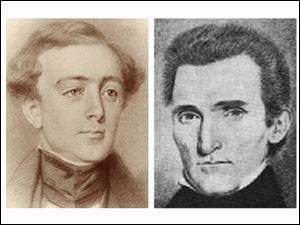
Stevens Mason, head of the Michigan territory, left, and Ohio Gov. Robert Lucas — two different personalities — squared off as adversaries in the Toledo War.
With the Super Tuesday primaries, including Ohio's, just around the corner on March 6, Toledoans will be bombarded with maps showing how the Buckeye State figures in the political landscape. But what if Ohio as we know it looked completely different?
Try imagining Ohio without Toledo. Or Cleveland. Or Akron. Others did. If the Founding Fathers had their way, Toledo would be in Michigan, as was called for in the Northwest Ordinance of 1787, the same year they wrote the U.S. Constitution.
And if a man named Zebulon Butler had succeeded, Cleveland and Akron would be in Connecticut. On today's electoral map, Ohio would be somewhere near Rhode Island and Wyoming.
In 1754, Connecticut maintained that the charter on which its boundaries were based extended to the Pacific Ocean, though it was willing to be reasonable and lay claim only as far as Sandusky Bay.
Connecticut called this land its western reserve, a vestige of which remains today in Cleveland under the name Case Western Reserve University. Mr. Butler became Connecticut's military leader in clashes with Pennsylvania known as the Pennamite-Yankee War, which erupted periodically between 1769 and 1799.
Pennsylvania won, which kept the future cities of Cleveland and Akron within the soon-to-be created state of Ohio. Toledo, however, was still up for grabs.
The Northwest Ordinance defined the future Ohio-Michigan border as a line level with the southernmost point of Lake Michigan. After it was discovered that the map Congress used was inaccurate, it was also found that the line put Toledo in Michigan.
To keep this port, Ohio tilted the line slightly north when it became a state in 1803. Michigan didn't utter a peep -- though there were few pioneers there to peep.
Then a 19-year-old named Stevens Mason showed up. In 1831, his father was the territorial secretary of Michigan. After a meeting with President Andrew Jackson, Mr. Mason's father left for the Mexican province of Texas (which was itching for independence) for unstated reasons. President Jackson appointed the young Mason to replace him.
People in Michigan were outraged by this appointment. In 1834, when Michigan's governor died, his duties went to Mr. Mason. The new, young governor harnessed Michigan's rage by laying claim to the border stipulated by Congress.
There was an additional reason: A canal connecting the Maumee River to the Wabash River was in the works. With it, in this pre-railroad era, commerce could flow from New Orleans along the Mississippi River to the Ohio River, the Wabash River, the Maumee River, the Great Lakes, the Erie Canal, the Hudson River, and New York harbor.
The hub of the western waterways leading to and from the canal would be Toledo.
In response to Mr. Mason's challenge, Ohio Gov. Robert Lucas sent surveyors to the disputed zone. Mr. Mason said he would evict anyone from Ohio who laid claim to the land. Governor Lucas responded with words along the lines of: You and whose army?
Mr. Mason replied, in effect: Mine. He dispatched Michigan's militia. Governor Lucas did likewise, thereby commencing the Toledo War.
The two men couldn't have been more different. Mr. Mason came from a refined Virginia family whose relatives included George Mason, author of the Virginia Bill of Rights, which formed the basis of the nation's Bill of Rights, and John Mason, who in colonial times owned a parcel of land known today as New Hampshire.
Mr. Lucas was 30 years his senior and came from a hardscrabble pioneer family.
Mr. Mason declared that "outrages of a most unjustifiable and unparalleled character have been committed by a number of persons at Toledo upon officers of the [Michigan] Territory." If Ohio "is permitted to dragoon us," he warned, "all law is at an end."
Governor Lucas noted that residents of Toledo "have been driven from their houses in dread and terror … by the authorities of Michigan." These acts, he asserted, were "scarcely paralleled in the history of civilized nations."
Mr. Mason relented when Congress offered Michigan the peninsula of land extending from Wisconsin. Wisconsin didn't utter a peep, for the same peep-lacking reason as in Michigan years before.
The residents of Ohio and Michigan showed their gratitude to these governors by soon voting them out of office. Mr. Lucas became the territorial governor of Iowa, where he immediately faced an identical boundary dispute with Missouri.
This time, however, he lacked voting rights in Congress or the backing of the president. He faced off against the governor of a state. But Mr. Lucas won that one too.
Mr. Lucas is remembered today in the name of the county that includes Toledo. His impact will remain alive when Toledo goes to the polls and adds its voice to those of two other large Ohio cities, Cleveland and Akron, in the presidential primary that is part of Super Tuesday.
Mark Stein is a historian and author of "How the States Got Their Shapes Too: The People Behind the Borderlines."