
Cleveland follows lead of Toledo on ‘pit bull’ dogs
Behavior to determine animal’s danger, not breed
6/26/2011
Dog advocates says it’s wrong to label a certain breeds, such as this ‘pit bull’ puppy, as inherently vicious. The Ohio General Assembly is expected to vote by the end of this month on whether to remove the ‘pit bull’-specific language from state law.
The Blade
Buy This Image
Editor's note: This version of the article corrects that it is a law against 'pit bulls,' not a ban.
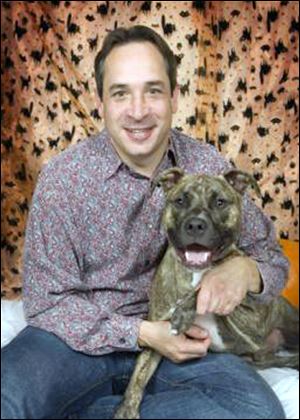
Cleveland Councilman Matt Zone rescued Gordon, a ‘pit bull,’ after the puppy was hit by a truck three years ago.
As the Ohio General Assembly debates whether to end a law that brands “pit bull”-type dogs as inherently vicious, Cleveland has followed Toledo’s lead in banning the labeling of dogs as “dangerous” simply because of their breed.
Cleveland City Council this month approved changes to the city’s vicious-dog ordinance requiring that dogs be classified based on their behavior and not because they fall into the “pit bull” category. The changes echo Toledo’s own overhaul of its vicious-dogs regulations in October.
“It just seemed fundamentally wrong to say that a certain breed is bad. That’s like me saying that all people that come from northwest Ohio aren’t good people,” said Cleveland Councilman Matt Zone, who introduced the legislation. “In today’s day and age to really determine and know what a breed is [is] virtually impossible with all of the cross-breeding that goes on.”
Under the changes in Cleveland, authorities can classify any type of dog as a “Level 1” threat to public safety if it attempts to cause harm to a person or domestic animal, and as a “Level 2” threat if it bites or otherwise injures a person or animal.
Owners of these dogs must abide by strict regulations that include keeping the animal in a secure enclosure, muzzling the dog while out in public, and obtaining a minimum of $100,000 in liability insurance. Those who violate the rules can be fined up to $1,000.
The rules are similar to those laid out in Toledo’s vicious dogs ordinance, which also classifies dogs based on their behavior, imposes almost identical restrictions on those dogs considered a threat, and pushes owner responsibility.
Toledo City Council’s law and criminal justice committee tomorrow is to review changes to the enforcement aspect of its dog law — removing the Lucas County dog warden as the principal enforcer.
An eye on Toledo
Mr. Zone acknowledged that he has been following events in Toledo closely and was inspired by the passage of the city’s dog ordinance last year.
“I was really proud as a policy maker and as a dog owner to see the foresight and vision on the [Toledo City] council’s part to examine this based on fact, not fear,” the councilman said. “Too often you get council people who will try to make policies based on fear or peer pressure that they’re hearing from the community.”
Despite the local changes, “pit bull” owners continue to face requirements for additional restraint, muzzling, and liability insurance under state law.
The Ohio General Assembly is expected to vote before the end of this month on whether to remove the “pit bull”-specific language from the law.
Sharon Harvey, executive director of the Cleveland Animal Protective League, called Cleveland’s new regulations “fantastic.” She said “pit bulls” are no more likely than other types of dogs to act aggressively.
“‘Pit bulls’ have been misrepresented and I think misclassified as dangerous dogs. We truly need to look at actual behavior,” Ms. Harvey said. “The focus that society has put on ‘pit bulls’ has been dangerous. We’re not spending enough time looking at dogs that truly do pose a threat.”
Suburban bans
That opinion is not shared by some of Cleveland’s neighboring cities. Lakewood and Garfield Heights just outside Cleveland passed “pit bull” bans in recent years.
Lakewood Law Director Kevin Butler, who as a former council member voted for a ban on new “pit bulls” in the city in 2008, said the decision was based on concerns for public safety amid a proliferation of the dogs in his densely populated community.
“I think the studies bear out that more deaths by dog bites and serious injures come at the jaws of ‘pit bulls’ than any other types of dogs,” Mr. Butler said. “I think we erred on the side of caution, particularly in a city as dense as ours.”
Carol Miller of Olmsted Township, who was attacked by a “pit bull” in a Cleveland-area park in 2007, said she doesn’t favor changing laws targeting the dog. In a statement to The Blade, Ms. Miller said she believes the state law on “pit bulls” has succeeded in saving people from vicious dog attacks and helps ensure victims are covered by liability insurance.
“I favor what works to save lives and pay medical bills for victims,” Ms. Miller said. “Law in Ohio has done this.”
“Pit bull” is a generic descriptive term for a dog trained to fight and may refer to multiple breeds, including the American Staffordshire terrier, Staffordshire bull terrier, and American pit bull terrier.
Saving a puppy
Mr. Zone said he turned firmly against breed-specific laws after he rescued a “pit bull” puppy run over by a truck outside his office three years ago. When the animal control officer arrived, Mr. Zone said he was informed the puppy would be automatically destroyed because it was a “pit bull.” The councilman begged to keep the dog himself and nursed it back to health. He said the now-grown dog, named Gordon, is sweet and gentle and has become a much-loved member of his family.
“It just goes to show that when you show love and care to an animal they give it back tenfold,” Mr. Zone said. “That further cemented my resolve to create a law that was based on the action of the animal not the breed of the animal.”
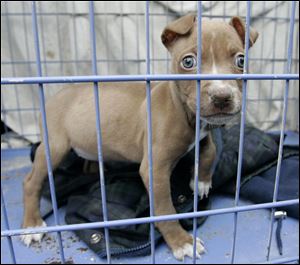
Dog advocates says it’s wrong to label a certain breeds, such as this ‘pit bull’ puppy, as inherently vicious. The Ohio General Assembly is expected to vote by the end of this month on whether to remove the ‘pit bull’-specific language from state law.
John Dinon, executive director of the Toledo Area Humane Society, applauded Cleveland’s move toward breed neutrality.
“We are in favor of this type of legislation,” Mr. Dinon said.
“This whole obsession with ‘pit bulls’ I think is a distraction for truly effective public policy on dangerous dogs. The fact that people are now looking at dog behavior and owner responsibility is a huge step toward making our communities and Ohio safer places.”
Mr. Dinon added that Toledo must now work on ensuring that its own ordinance is properly enforced, something he said is currently not happening.
On the local front
Toledo Councilman Rob Ludeman, a member of the Lucas County Dog Warden Advisory Committee, said Dog Warden Julie Lyle has not wanted to enforce certain parts of the municipal code, and the city has no authority to direct a county employee.
“Wherever she declined to do that, ‘dog warden’ was taken out of the law and humane society has been left in — that is the basic difference,” Mr. Ludeman said of the latest proposed change that is subject to approval from the full council.
“Despite the fact that we put all that work in and the Lucas County Commissioners appointed the dog warden advisory committee in the first place,” Mr. Ludeman said. “We worked for a long time on that. It was passed in October and never put into effect because there was not a renewal of service [contract] with the dog warden and a reluctance of the dog warden to enforce parts of the new code.”
Toledo Law Director Adam Loukx said: “Originally we thought because we were going to go into contract with the dog warden that she would be involved in enforcing things. We don’t have an agreement so there is no reason to keep it in there.”
Councilman D. Michael Collins, chairman of the law and criminal justice committee, said council will debate what role the city’s police department will play in enforcing dog laws, including issuing summonses to dog owners, seizing vicious dogs, and notifying owners of their responsibility as it relates to the level of threat as defined by law.
“What I envision happening is that the division of police will assume responsibilities once we can establish sworn personnel who will serve as animal control officers,” Mr. Collins said.
Council this week also could vote on a new one-year contract with the dog warden. According to the legislation, the city has tentatively agreed to terms with the Lucas County commissioners for dog warden services for a one-year period.
Under the proposed terms, the dog warden would agree to enforce certain provisions of Toledo Municipal Code, including the section titled “Rabies Immunization Required,” but the dog warden will not enforce other provisions, including a section titled “Dogs Which Pose a Threat to Public Safety.”
Additionally, the dog warden would charge $155 for each after-hour call made by the city Monday through Saturday and $205 a call on Sundays and holidays.
The agreement also calls for the payment of a onetime “stand-by fee” of $20,000. Mr. Collins suggests the city could save money by using Toledo police officers to perform those duties.
Staff writer Ignazio Messina contributed to this report.
Contact Claudia Boyd-Barrett cbarrett@theblade.com or 419-724-6272