
Latest poll shows Brown with big lead over Mandel
1/19/2012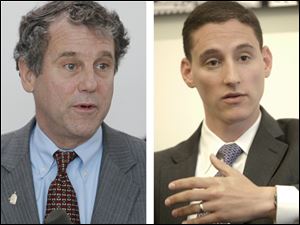
U.S. Sen. Sherrod Brown (D., Ohio), left, and Ohio Treasurer Josh Mandel.
COLUMBUS — More than seven months out from the general election, U.S. Sen. Sherrod Brown holds a commanding lead over Republican challenger Josh Mandel among registered Ohio voters, according to the latest Quinnipiac Poll released Thursday.
The electorate is nearly evenly divided over the so-called Heartbeat Bill, a measure now pending in the Ohio Senate that would give the state the most restrictive abortion law in the nation.
Voters, however, sent a mixed message on Ohio’s renewed interest in natural gas drilling. They said by a margin of 64 percent to 29 percent that the economic benefits of such drilling would outweigh environmental concerns while also saying, 72 percent to 23 percent, that the practice most looked at for such drilling, “fracking,” should be placed on hold pending further study.
Hydraulic fracturing involves using fluids and chemicals at high pressure to fracture underground shale to release the fossil fuels trapped within.
Voters, meanwhile, still have a negative opinion of Republican Gov. John Kasich. Thirty-nine percent said they approve of his job performance while 48 percent say they don’t. Those numbers, however, are a tick better than the last poll in October when he had a 38 percent approval rating and 50 percent disapproval.
Forty-seven percent of those polled said that, if the election were held today, they would vote to give Mr. Brown a second term compared to 32 percent who prefer Ohio Treasurer Mandel. However, support for Mr. Brown has dropped 2 percentage points while Mr. Mandel has seen a corresponding increase since the last poll in October.
Twenty-one percent say they are undecided, support someone else, or don’t plan to vote at all.
“Sen. Sherrod Brown is in good shape for reelection, but 30 percent of voters say they don’t have an opinion about him, and an even greater number say the same thing about his challenger,” said Peter A. Brown, assistant director of the Quinnipiac University Polling Institute. He is not related to the Democratic senator.
“Mandel is pretty much an unknown to most Ohio voters and the race will be determined by whether Mandel’s ability to fill in the blanks in voters’ minds positively exceeds Brown’s ability to do so about him negatively,” he said.
The Connecticut-based university has been tracking voter sentiment in a handful of key battleground states like Ohio. The poll of 1,610 registered voters between Jan. 9 and 16 has a margin of error of plus or minus 2.4 percentage points.
The Heartbeat Bill would require a doctor to test for a fetal heartbeat and would prohibit an abortion if one is detected. That could occur as early as six weeks after conception. The bill has passed the House, but the Senate doesn’t plan to take it up again for hearings until after the March 6 primary election.
Supporters of the bill argue that the detection of a heartbeat is the best indicator that a fetus is likely to be carried to full term and that the inevitable legal challenge would give the U.S. Supreme Court a vehicle with which to overturn the 1973 Roe v. Wade decision extending a woman’s constitutional right to privacy to decisions pertaining to abortion.
Opponents, however, argue that the law would effectively outlaw abortion altogether, noting that a detectable heartbeat could be present before a woman even knows she’s pregnant. The issue has even divided members of the pro-life community as some argue a direct assault on Roe v. Wade with the current court is premature and could endanger other gains the movement has experienced recently with the Republican-controlled General Assembly.
“Abortion remains perhaps the most divisive issue in the nation, and there is an almost even split among Ohio voters over the fetal heartbeat bill,” said Quinnipiac’s Mr. Brown.
“Despite a partisan split over the issue, where Republicans support the measure 2-1 while Democrats oppose it 2-1, lower-income voters, who tend to be Democrats, support the bill while high-income voters, who tend to be Republican, oppose it,” he said.