
Michigan, Canada sign accord for new bridge
$4 billion project called investment in economy
6/15/2012
The announcement of a planned second bridge over the Detroit River linking Canada and the United States drew protesters in Detroit, where the deal was signed Friday
The Blade/Jeremy Wadsworth
Buy This Image
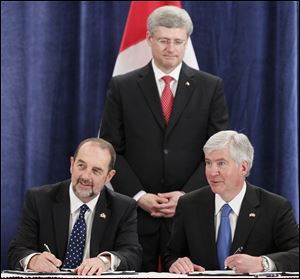
Canadian Prime Minister Stephen Harper watches Canada's Transport Minister Denis Lebel, left, and Michigan Gov. Rick Snyder sign an agreement for the construction of a new international bridge between Detroit and Windsor, Ontario.
WINDSOR, Ontario — A long-awaited second bridge connecting Canada and Detroit will become a reality, promised Canadian Prime Minister Stephen Harper and Michigan Gov. Rick Snyder, who signed a deal in Detroit hours after making the announcement in Windsor on Friday.
"We shall launch a truly visionary project," Mr. Harper said in making the announcement — drawing thunderous applause and cheers from Canadian and U.S. dignitaries.
While the span itself will cost $1 billion (in U.S. dollars), the accompanying projects, including Canadian and U.S. inspection plazas, an I-75 interchange, and the Windsor-Essex Parkway connecting Canada's Highway 401 to the bridge, are expected to push the entire cost to $4 billion. The project is likely to take about four or five years to complete.
The prime minister called the bridge an investment in the future of the North American economy.
"It's a sign of our determination to move forward during the difficult time in the global economy, and of course it's a celebration of the friendship that exists between Canada and the United States," Mr. Harper said.
"Once this bridge is complete, congestion will be reduced and trade will be accelerated in both directions," Mr. Harper said in English and French.
Under the deal, Canada will pay Michigan's $550 million in construction costs and the money will be recouped through tolls on the bridge, which will stretch between Brighton Beach in Windsor's west end to Detroit's Delray section, just northeast of Zug Island.
Canada also will pay for land acquisition on both sides of the border and will pay to connect the bridge to I-75 between the Ambassador Bridge and the Rouge River Bridge. Tolls will be charged on the Canadian side only, to reimburse that country's government for costs.
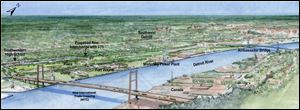
This artist’s rendering shows the proposed Canadian-financed bridge over the Detroit River that will add a new link between the United States and Canada.
The deal does not require approval by the Michigan legislature but is subject to approval by the U.S. secretary of state, in accordance with provisions of the U.S. Constitution and federal law.
Canada will be responsible for design, construction, finance, operation, and maintenance, but Michigan will have significant control through an international authority. Three members would be appointed by Canada and three by Michigan.
"I'm proud to say the Detroit-Windsor crossing is the busiest trade crossing on the border — 8,000 trucks a day, at least, going back and forth," Governor Snyder said. "But we're also the biggest bottleneck on the Pan-American highway. So we're also impeding commerce, and trade, and growth, so it's relatively clear we need to build a new crossing."
The governor said the jobs created by the project are crucial for the state. "We need more and better jobs."
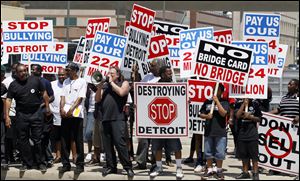
The announcement of a planned second bridge over the Detroit River linking Canada and the United States drew protesters in Detroit, where the deal was signed Friday
After the formal announcement, Mr. Snyder said it was not clear how many jobs would be taken by Canadians and how many by Americans.
He referred to a recent study by the Center for Automotive Research in Ann Arbor that estimated 12,000 jobs would be created for each of the four to five years of construction and more than 8,000 permanent jobs would be created in southeast Michigan once the bridge is open.
U.S. Transportation Secretary Ray LaHood called Mr. Snyder a "man of vision" for his commitment to the bridge project.
"It's a big deal for both of our countries, but it's a particularly big deal for people who want to go to work, for people who are bridge-builders, for people who know how to build roads, for people who need a job," Mr. LaHood said. "That's what this is about."
Bill Ford, Jr., executive chairman of Ford Motor Co., who attended the signing ceremony in Detroit, applauded the deal and said it would help his company.
Congestion on the Ambassador Bridge has been a problem for automobile makers, he said.
"Any time you get hung up, it costs you time and certainly costs you money," Mr. Ford told reporters. "This will be a huge boost to us as we send parts, powertrains, and vehicles back and forth across the border."
Although design of the bridge is not finalized, it is anticipated to be six lanes wide to better accommodate traffic flow. The length of the bridge is undetermined as of now but, for comparison's sake, the Ambassador Bridge is about 1.4 miles long.
Toledo Mayor Mike Bell, who did not attend either event, also lauded the deal.
"Toledo is located within an eight-hour drive of 60 percent of the North American population, including parts of Canada," Mr. Bell said. "I absolutely support any additional infrastructure that is going to improve our logistical position and increase the speed-to-market capabilities of businesses that choose to locate here."
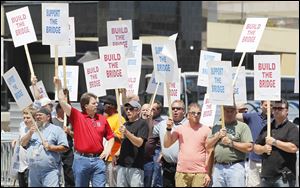
Supporters of a second bridge between Detroit and Windsor gather in Detroit on Friday. A recent study estimated 12,000 jobs will be needed for its construction.
Among the speakers who addressed a crowded room at Cobo Center just before the signing ceremony was John D. Porcari, U.S. deputy secretary of transportation, who said that "Ohio, Indiana, Kentucky — the whole I-75 corridor will benefit from this project."
In addition to the 84-year-old privately owned Ambassador Bridge, there are two tunnels under the Detroit River — one for passenger vehicles and one for trains.
A new bridge has been more than a decade in the making and is still controversial.
Canadian Prime Minister Jean Chrétien in 2002 said a new bridge costing $300 million would be built to supplement travel between the two countries, but the project was never started. In 2004, Prime Minister Paul Martin said he would build a bridge, but again it did not happen.
Recently, the project seemed imperiled after it was reported that Canada had an interest in using cheaper Chinese steel. Officials Friday said no Chinese steel would be used for the bridge.
Michigan House Speaker Jase Bolger (R., Marshall) said the state legislature plans to carefully review plans for the bridge.
"It appears Governor Snyder's plan does not involve any action by the legislature, so it seems he has found a way to accomplish his goal of a new bridge while addressing our chief concern of protecting taxpayers," the speaker said in a statement.
Mr. Snyder said legislative approval was not needed because the project won't use taxpayer money and no state appropriation is required to pay it off.
Manuel "Matty" Moroun, the billionaire owner of the Ambassador Bridge, has been fighting the construction of a publicly owned bridge for years and is still trying to block its construction.
Mr. Moroun's company is pushing a November ballot proposal that would require voters' approval to build an alternative bridge.
Mickey Blashfield, director of the People Should Decide ballot committee, said in a statement Friday that he welcomes Mr. Snyder "out into the public debate" about a bridge.
Contact Ignazio Messina at: imessina@theblade.com or 419-724-6171.