
Clock begins to wind down for aging housing complex
4/6/2008
Teresa Abernathy, president of the Central Residents Council, grew up at Brand Whitlock and is raising her three sons there. (BLADE PHOTOS/AMY E. VOIGT) <br> <img src=http://www.toledoblade.com/assets/gif/weblink_icon.gif> <b><font color=red>ALSO</b></font color=red>: <a href=" http://www.toledoblade.com/apps/pbcs.dll/article?AID=/20080406/NEWS03/804060308/" target="_blank "><b>Ohio's carry conceal law</b></a> <br> <img src=http://www.toledoblade.com/assets/gif/weblink_icon.gif> <b><font color=red>ALSO</b></font color=red>: <a href=" http://www.toledoblade.com/apps/pbcs.dll/article?AID=/20080406/NEWS17/804060355"><b>Theater reopens after explosion</b></a>
Teresa Abernathy has lived in the Brand Whitlock Homes - Toledo's oldest public housing complex - almost her entire life.
It's where the 36-year-old grew up, living with her grandmother during the 1970s and 1980s, and where she is raising her three sons, Tony, Tobias, and Tyland.
Here, she said, she knows her neighbors and they know her.
"And if my kids are involved with anything they shouldn't be, my neighbors let me know," she said with a laugh.
Though public housing sometimes has a bad reputation as a haven for crime or drugs, this place is home, Miss Abernathy said on a recent morning, sitting on the stoop outside her home and enjoying the warm spring air. She is understandably apprehensive about a plan to give Brand Whitlock a major overhaul - part of a national trend to replace some of the nation's oldest public housing.
The homes of Miss Abernathy and her neighbors will likely be completely transformed - either massively renovated or even torn down with entirely new structures rising up in their place, as has happened with older public housing in cities across the country.
"I love the Brand Whitlocks," Miss Abernathy said, using the name by which many residents refer to the complex.
"If I had a choice, I would not move."
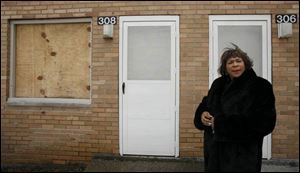 Photo gallery" rel="storyimage1" title="Clock-begins-to-wind-down-for-aging-housing-complex-2.jpg"/>
Veronica Brown, housing manager at the complex, estimates that about 18 percent of the 346 units are uninhabitalbe, many because of mold issues. In other units, the bathrooms need upgrades. <br> <img src=http://www.toledoblade.com/assets/gif/weblink_icon.gif> <font color=red> <b>VIEW</font color=red></b>: <a href=" http://www.toledoblade.com/assets/slideshows/brand/index.html"><b>Photo gallery</b></a>
Miss Abernathy, who serves as president of the Central Residents Council, which represents the thousands of tenants living in Lucas Metropolitan Housing Authority public housing, will attend a meeting with other residents on Thursday to find out more and give LMHA leaders input about what should be done with her home.
In addition to the planned redevelopment at Brand Whitlock - which includes more than 30 buildings, almost 350 homes - the adjacent Albertus Brown Homes, more than 50 homes that are nearly as old as those in Brand Whitlock, are slated for redevelopment.
Located between Division Street and Belmont, Weiler, and Nebraska avenues, Brand Whitlock opened in 1938.
It was the Great Depression - and Brand Whitlock was among the nation's earliest public housing complexes, built by the New Deal-era Public Works Administration.
Hundreds of blighted homes were torn down to make way for the new buildings.
At the groundbreaking ceremony in 1936, A.R. Clas, an official with the PWA, told the audience:
"Brand Whitlock Homes will rise from the ashes of sordidness, vice, and crime, dedicated to serve a twofold purpose shaping a neighborhood design for eventual rehabilitation of the entire district and at the same time furnishing the means for wiping out the worst section of the city."
Though many people now associate public housing with poverty, that was not always the case.
In 1938, Brand Whitlock's 246 units all had new appliances.
"The area has been transformed into a relative paradise of two and three-story fireproof brick structures, equipped with the most modern facilities," said one newspaper article. "Each apartment has ample closet space, lighted hallways, full-sized living and bedrooms and baths."
Demand for the apartments was such that many families were turned away. By the following year, plans were under way for an expansion, and an annex containing an additional 112 units opened in 1940.
The Albertus Brown homes opened in 1941 with more than 100 units.
In addition to those complexes, LMHA has four other properties that were built before 1950.
Many people who would grow up to be prominent Toledoans got their start in Brand Whitlock. Former city council member June Boyd spent much of her childhood here. Vice Mayor J.B. Simmons, Jr., Toledo's first African-American fire captain, Robert "R.D." Herron, and entrepreneur Stanley Cowell all called the place home at one time.
"Initially, in many places, public housing was to help people who needed a bit of help," explained Diane Levy, a research associate with the Urban Institute, a Washington, D.C.-based, nonprofit policy research institute focusing on urban affairs. "Generally, somebody was employed, and [public housing] was seen as somewhat of a steppingstone."
Throughout the following decades, however, several things changed the nature of public housing.
In 1969, the Brooke Amendment removed ceiling rents, which meant families would have to pay 30 percent of their income for rent with no upper cap on rent level, Ms. Levy said.
Today there are federal income guidelines in place outlining who can live in public housing.
"[Removing the cap] meant that households with increasing income had an incentive to rent on the private market where the rent amount was not pegged to income, rather than pay higher and higher rent in public housing," she explained.
"Another factor was the shift under the Reagan administration that gave homeless persons priority for public housing units," she said.
These changes brought poorer and poorer people into public housing as people with better resources moved away, turning it into the "housing of last resort."
Further blows, Ms. Levy said, were the loss of the manufacturing base and the drug epidemics during the 1980s, along with insufficient funds from the U.S. Department of Housing and Urban Development for property maintenance.
The end result?
"Tenant bases with a population of very poor people with very few resources," she said.
Through the decades, the changing nature of the nation's public housing could be witnessed firsthand by Brand Whitlock and Albertus Brown residents.
By the late 1980s, drug sales were intense, housing authority officials and police said, with drug dealers operating out of apartments, moving every few days to avoid getting caught.
In 1989, Brand Whitlock was more than half vacant and known as one of the housing authority's most run-down and drug-plagued areas.
But less than a decade later, things had improved when the local housing authority was recognized in 1996 by President Bill Clinton and HUD Secretary Henry Cisneros for its "one strike" policy that allowed the authority to evict anyone involved in criminal activity.
It was around this same time that the public's - and lawmakers' - conscience was turning to the problems of the worst public housing projects.
The 1991 bestselling book There Are No Children Here: The Story of Two Boys Growing Up in the Other America chronicled the lives of two boys in the Henry Horner Homes in Chicago. The book brought attention to the crime and misery that children endured in some of the worst public housing.
In 1992, the National Commission on Severely Distressed Public Housing found about 86,000 units - about 7 percent of all public housing - were distressed.
This prompted the passage of the HOPE VI program, which, in the words of one HUD study, "represents the most dramatic change of direction in the 60-year history of U.S. public housing policy. It promises nothing less than a full transformation of the nation's most distressed public housing projects."
Lucas County Metropolitan Housing Authority officials want to take advantage of funds from the HOPE VI program to overhaul Brand Whitlock, said Linnie Willis, executive director of LMHA. But just how will Brand Whitlock and Albertus Brown change?
LMHA is still gathering opinions from residents before putting forward a plan, Mrs. Willis said.
While the buildings could be modernized, Mrs. Willis said it likely makes more sense to raze the structures and start over.
"I don't know if it would be a wise investment to spend the kind of money that would need to be spent on some of those issues, as opposed to just tear it down," she said.
While some units are fine, in many ways, time has caught up with the buildings' old bricks, pipes, and boilers.
"We've got units that are not habitable because of mold and mildew," Mrs. Willis said. "We've gone and scrubbed and bleached, but the mold just comes back so quickly you can't have a family living in there."
Brand Whitlock Property Manager Veronica Brown estimates that about 18 of Brand Whitlock's 346 units are uninhabitable, many because of mold issues. Other units can't be lived in because in one building, a stairwell is so severely rusted it isn't safe.
In other units, even ones that are vacant, heat goes out the windows, because the antiquated boiler system can't be regulated in individual apartments.
On a recent afternoon at Brand Whitlock, papers, plastic bags, and other trash is scattered on a few of the lawns, but most appear well-kept.
The sidewalks have been cleared of recent snow and the doors of several apartments have been decorated with American flags, wreaths, or stickers. Plants are visible in some windows; in another hang curtains with a cheerful fruit pattern.
Ms. Brown gestures around one of the two-story units. The apartment is clean, spotless, in fact. The refrigerator and stove appear to be in good condition.
Still, the apartment looks, well, old. The brown linoleum floor resembles something left over from the disco era, as do the wooden doors. Even though the apartment is empty, it's very warm, because, Ms. Brown explains, with the antiquated boiler system in the building, each apartment can't control its own heat. The bedrooms are very small.
"The tub, the vanities, the hardware, they are old and they need to be replaced," Ms. Brown says, gesturing to the tiny bathroom.
Though the exterior brick walls are sturdy, the unit's tiny rooms are functionally obsolete.
For her part, Miss Abernathy said even though she is apprehensive about how the process will be carried out, she understands why the buildings need to be redeveloped. The apartments aren't sturdy enough to stand up to the wear and tear of young children, and the bathrooms are far too small, she said.
"I just hope [LMHA] keeps in mind the residents," she said, "and keeps it affordable for us."
Contact Kate Giammarise at: kgiammarise@theblade.com or 419-724-6133.