
ON THE LOOKOUT
Block Watch key to safe neighborhoods
8/3/2011
Toledo Police Chief Mike Navarre says Block Watch programs are a link to the neighborhoods.
The Blade/Dave Zapotosky
Buy This Image
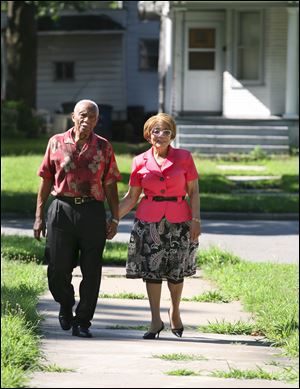
Oscar and Leola Haynes are active participants in their neighborhood Block Watch program.
Anybody old enough to remember how safe neighborhoods felt several decades ago also will recall that it was because people looked out for one another and took action if they saw anything that wasn't quite right.
These days, though, in such a highly mobile society where people constantly are coming and going, residents often know little to nothing about their neighbors. And sometimes younger generations need to be persuaded to look out for their neighbors and to watch for suspicious activity.
Keeping a watchful eye in the neighborhood is key to keeping crime rates low, neighborhoods safe, and to helping law enforcement agencies do their jobs, which is why Toledo Neighborhood Block Watch organizations unite areas and put criminals on notice.
"The key to Block Watch programs is that they are our link to the neighborhoods," Toledo Police Chief Mike Navarre said. "They provide that avenue ... for us to communicate with the neighborhood. It's so much more efficient to do that in a group setting."
Neighborly nosiness applies to anyone who wants to stay informed and to maintain a safe living environment.
Toledo's Block Watch President Leola Haynes knew nothing about the program when more than a decade ago she noticed gang activity in her Forest Avenue neighborhood. She wanted to learn about what others knew, and in the process, she aimed to raise awareness and combat the problem. That's when Mrs. Haynes invited neighbors to her home to address the issue. That's when she learned about Block Watch.
"It's a beautiful area and I didn't want to move," she said about her central city neighborhood that's just a few minutes from the Toledo Museum of Art and the YWCA in downtown Toledo. "I decided to get with the group to get our community back to where it was."
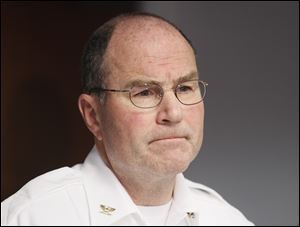
Toledo Police Chief Mike Navarre says Block Watch programs are a link to the neighborhoods.
So the retired elementary school teacher and former nurse became involved with Block Watch, a program that is very much alive and thriving in the city. As a result of the recent crime spree that included fatal shootings, Mrs. Haynes said there is renewed interest in the program.
The city's eight Block Watch sectors have 180 areas, and each sector's leader oversees nine to 12 blocks, Mrs. Haynes said. Groups' meeting times vary, from those that meet monthly to others that meet every other month.
Block Watch leaders know the right municipal department to contact when there are other problems in their neighborhoods, such as when yards need to be mowed and refuse containers in the parks overflow.
Mayor Mike Bell wants the police department to be 625 strong, the police chief said. Right now, though, there are only 552 police officers. That number makes the role Block Watch programs play that much more vital.
"We rely on people calling 911 and Block Watch leaders," Chief Navarre said. "That's the whole point, to get involved and look out for your neighbors. They do that every day. I can't tell you that we categorize success stories, but we have a lot of success stories because people call 911, even though it's hard to measure crimes that you prevent."
This much is certain about anyone who becomes involved in Block Watch: a resident can't help but learn about his or her surroundings.
"We found out by getting our flyers out that almost half the houses were empty," Mrs. Haynes said. "People moved and died, and that invited a lot of squatters in and that's what the gangs were using the neighborhood for, a place to sell drugs."
Citizens, however, should not confront anyone suspected of criminal activity. Block Watch teaches that citizens are not to take the law into their own hands. They are only to make observations and to call 911.
"That's safest for everyone. What we do is watch out for each other," said Mrs. Haynes. "I believe in Block Watch."
Contact Rose Russell at rrussell@theblade.com or 419-724-6178.