
Seneca County focus shifts to probate, juvenile courts
1/30/2012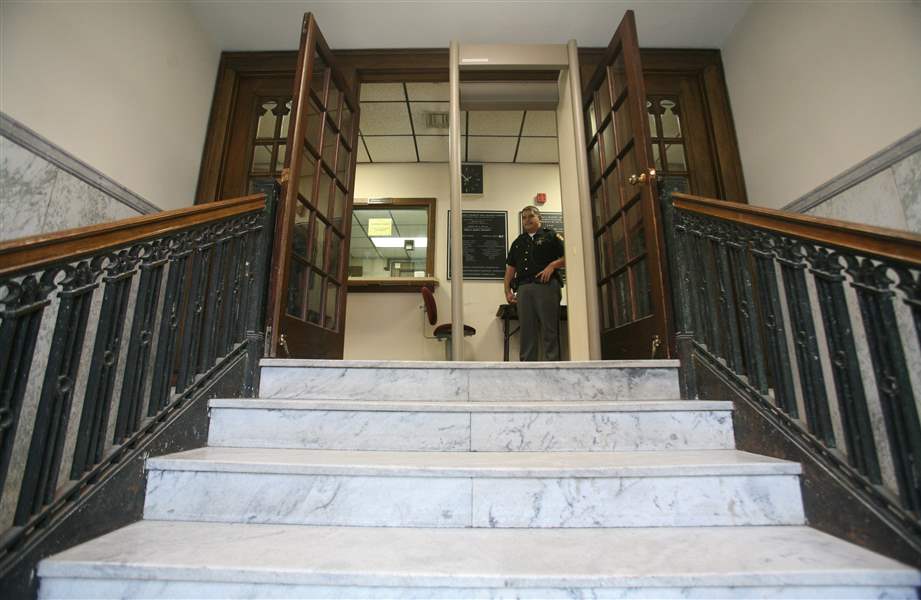
A marble staircase leads from the front entrance to the main floor, an insurmountable obstacle for a person in a wheelchair.
The Blade/Jeremy Wadsworth
Buy This Image
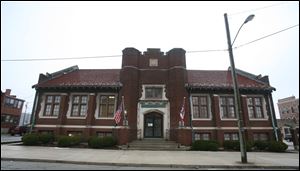
The courts took over the 1912 building in 1975 when the library moved into new quarters a block away. Space was designated at the annex to the county courthouse, but two common pleas courts took that.
TIFFIN — Seneca County Sheriff’s Deputy Bryan Bernal sits at the top of the steps leading to the county’s juvenile and probate courts, directing visitors to come upstairs to pass through a metal detector — and watching for those who can’t.
“When people come in wheelchairs, I go down there and see what they want,” he explained. “A lot of times a clerk will go outside to help them.”
The two courts are squeezed into a well-kept, but difficult to enter, Carnegie library built in 1912 with $25,000 from industrialist Andrew Carnegie. The Tiffin-Seneca Public Library called the two-story Tudor building home until 1976, when it moved to a new building a block away.
The probate and juvenile courts, which had been housed in the 1884 courthouse across the street, then moved into the 6,000-square-foot library building.
Thirty-five years later, the courts’ caseloads have grown, their services have expanded, and security requirements increased, making for a cramped public space.
A marble staircase leads from the front entrance to the main floor, an insurmountable obstacle for a person in a wheelchair.
“What’s amazing about the staff that I inherited is they just accommodate. They do everything they can to get the job done, and they’ve done it,” he said. “We’ve operated out of here for 35 years. We’ve been able to perform all the functions of probate and juvenile court, and when folks have alerted us that there’s someone with a disability, we accommodate by using [a common pleas courtroom]. We’ve relocated hearings. Sometimes my probate clerks go out in the street to help folks if someone needs a marriage license or something signed. We go out to the people to make sure it gets done.”
Seneca County commissioners planned to relieve the courts’ congestion and inaccessibility in 2004 when the county built a three-story annex to the 1884 courthouse, but they ultimately moved the two common pleas courts into the space intended for the probate and juvenile courts.
The historic, but dilapidated, courthouse was closed by then. It sat idle until early this month when commissioners declared the county could not afford an $8 million plan to renovate the 128-year-old edifice and instead voted 2-1 to tear it down.
The probate and juvenile courts, in the meantime, remain where they’ve been since 1976.
The century-old Tudor-style Carnegie Library in Tiffin was built with $25,000 from industrialist Andrew Carnegie. Its conference rooms have been converted into offices, probation officers have offices away from the building, and many records are stored in several other county buildings.
Although renovating the 1884 courthouse would have gotten probate and juvenile courts out of their cramped quarters far sooner, Judge Meyer said he “really didn’t have a position” on the renovation versus demolition debate.
“I just hoped that we would do something, that the county would move forward,” he said.
Asked if he thought the demolition accomplished that, the judge said yes, in the sense that it brought awareness to his court’s plight.
“I don’t think we’re having the debate anymore about whether we need to do something about the handicap accessibility and space needs of our court,” Judge Meyer said. “The discussion has moved, because of the courthouse, to ‘What are we going to do?’ not whether we need to do something about it.”
He said he is thrilled that commissioners recently agreed to take advantage of a $1.8 million grant from the Ohio Department of Youth Services to build a 24-bed juvenile detention center, which he said was needed even more urgently than a new home for juvenile and probate courts.
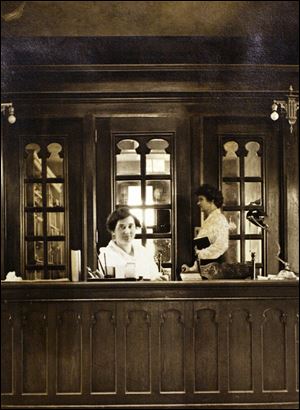
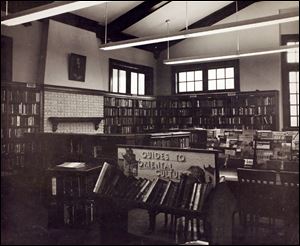
Wood paneling formed the front of a desk at the library early in its existence, and the desk’s arches were echoed in a door behind it.
At the court, conference rooms have been converted to offices. Probation officers have offices away from the court, some in area schools. Court records are stored in the boiler room and in several other county buildings.
The most pressing issue, though, remains the lack of accessibility for the disabled.
Seneca County Prosecutor Derek DeVine said he has not studied Title II of the Americans with Disabilities Act to know whether the court complies with the law, which requires all state and local governments to give people with disabilities equal opportunity to benefit from their programs and services.
Thomas J. Zraik, a Toledo lawyer who specializes in disability and elder law, said that in his opinion Seneca County’s probate and juvenile courts are “grossly, absolutely” in violation. He said the ADA, when it was signed into law in 1990, set no deadlines by which public buildings had to become accessible but allowed them to make alternative accommodations, such as installing temporary ramps or using a back entrance.
“What they envisioned is these alternative steps might take years, but they didn’t expect they would be made permanent,” Mr. Zraik said. “It’s been now more than 20 years since the enactment of the law, and continuing to rely on these methods for making their programs accessible is probably not going to be countenanced anymore. It’s not going to pass muster if somebody were to bring an action under the ADA.”
Judge Meyer said he is open to any ideas commissioners come up with for the courts.
“We’re going to work with the commissioners to consider any space that’s handicap-accessible and provides adequate space for our operations. I have no mandate to the commissioners for marble pillars or some big colossal courtroom,” Judge Meyer said. “We’ll work with the commissioners to get that done, and until that time, we’ll continue to make do.”
Contact Jennifer Feehan at: jfeehan@theblade.com or 419-724-6129.