
River Raisin re-enactors charge into bicentennial, battles saluted for key role in War of 1812
1/21/2013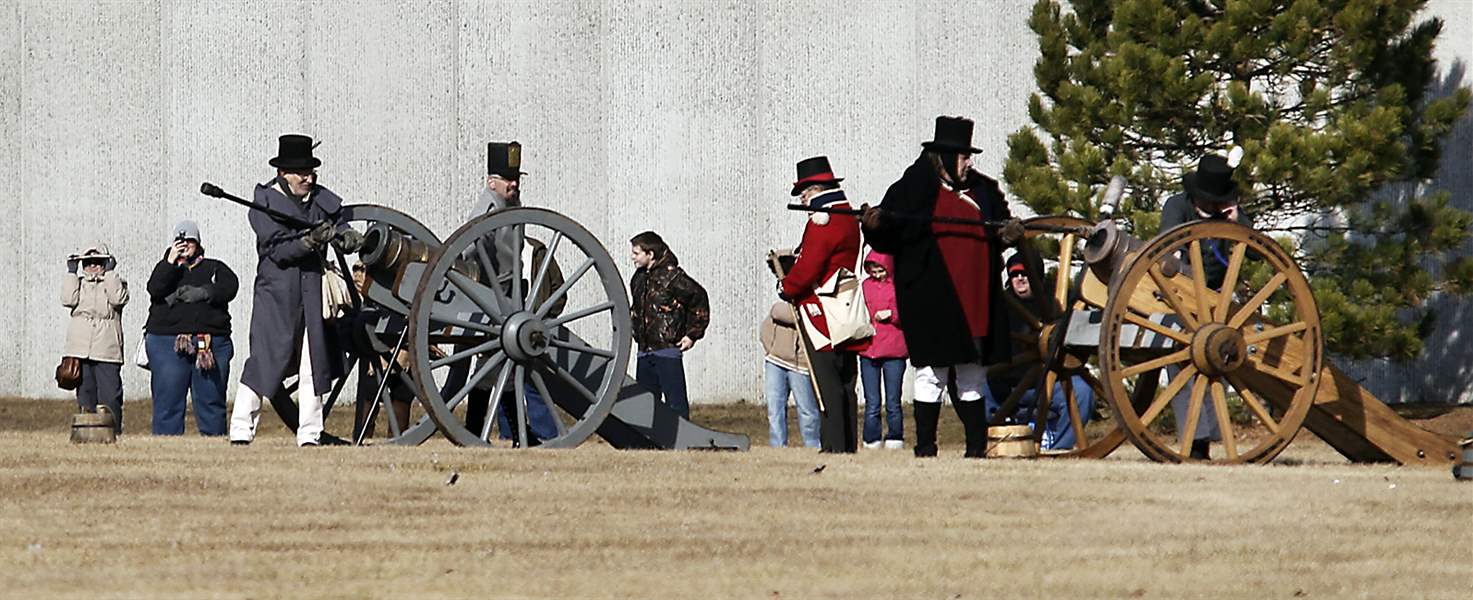
A crew reloads during a tactical demonstration on part of the battlefield near the Monroe Multi-Sports Complex. About 300 re-enactors from several states and Canada helped mark the bicentennial.
THE BLADE/LORI KING
Buy This Image
A crew reloads during a tactical demonstration on part of the battlefield near the Monroe Multi-Sports Complex. About 300 re-enactors from several states and Canada helped mark the bicentennial.
MONROE — They charged their weapons and fired. Some fell to the ground while others retreated, losing hats to the gusty, howling wind that failed to drown out the drumbeat and the booms of musket and cannon fire.
But the casualties weren’t real.
A battalion of re-enactors representing American regulars and militia met in mock battle Saturday at the River Raisin National Battlefield Park with a battalion of counterparts representing British, Canadian, and American Indian forces during a bicentennial celebration of the Battles of the River Raisin, fighting that occurred in present-day Monroe during the War of 1812.
“It was fun. And what a great turnout,” said Nathan Seger, 18, of LaSalle, Mich., his cheeks flushed from the wind and the excitement just after his battalion was dismissed at the end of its participation in the mock battle.
“Last year, we had only about three redcoats and about half the American troops we had today,” the Ida High School junior said.
PHOTO GALLERY: Battles of River Raisin bicentennial celebration
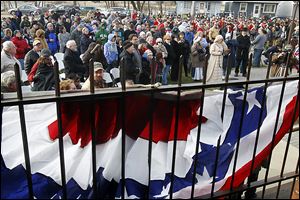
A crowd, some in period dress, gathers at the River Raisin National Battlefield Park Visitor Center during the 200th anniversary of the Battles of the River Raisin in Monroe.
Decked out as a sergeant in the LaCrosse Company of the U.S. forces’ French-American Regiment, the musket-wielding Mr. Seger was one of about 300 re-enactors from Illinois, Kentucky, Indiana, Ohio, Pennsylvania, Michigan, and Ontario, Canada, to re-enact one of the battles that occurred Jan. 18-22, 1813. At least five times as many people, many also sporting period costumes, watched from the treeline.
“I am here because I love history. It’s my favorite thing to do: to dress up and go outside and shoot my musket,” said Chase Blackwell, 12, of Monroe, who was dressed as a private in the British army.
The sixth grader at Monroe’s Triumph Academy said it took him a week and help from family and friends to make the uniform and the musket.
Community groups had planned Saturday’s activities for about five years. Besides the mock battle, or “tactical demonstration” as listed in the day’s program, highlights included a flag and wreath-laying ceremony, the re-enactors’ march to the battlefield, and a ceremony to honor fallen Kentucky soldiers.
Several people standing in the front became emotional when the national anthem was played for the flag and wreath-laying ceremony, when a period U.S. flag with 15 stars and 15 stripes was raised.
“The raising of the flag and hearing the people of my city sing the ‘Star-Spangled Banner’ brought tears to my eyes,” said Bradley Egen, 40, of Kalamazoo, Mich., a film director and producer who identified himself as a descendant of the Nadeaus and the DeLisles, two of Monroe’s founding families.
Francois Navarre, a French-Canadian trapper, was the first white settler to locate permanently in the area, then known as Frenchtown, in 1780.
13abc.com: Breaking News, Weather and Sports
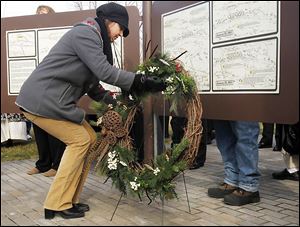
Alma Moore-Egen, a descendant of the Navarre family, lays a wreath at the battlefield's visitor center. About 30 members of the Navarre family fought in the battles.
“My entire family is heavily involved in preserving history. It is important to me and my family to help preserve the memory of the people who came before us,” Mr. Egen said, noting his wife, Alma Moore-Egen, 39, a descendant of the Navarre family, attended the event. He said 30 members of the extended Navarre family fought in the Battles of the River Raisin.
The battles raged in a roughly 2-square-mile area, with the heart of the battlefield on 70 to 100 acres along the river’s north bank, said Ralph Naveaux, a historian, author, and president of Friends of the River Raisin Battlefield.
In the summer of 1812, the British and their allies occupied the Michigan Territory, including Frenchtown along the River Raisin. U.S. forces on Jan. 18, 1813, succeeded in liberating the area from British control in what was the opening Battle of the River Raisin, Mr. Naveaux said. But it was the Jan. 22 counterattack from British, Canadian, and Indian forces that would prove devastating for the United States.
Early that morning, American Gen. James Winchester raced on horseback to the battlefield from the house where he was staying. Locals anticipated the British would return, and General Winchester’s host, Lt. Col. Francois Navarre, had a horse saddled and ready for the general.
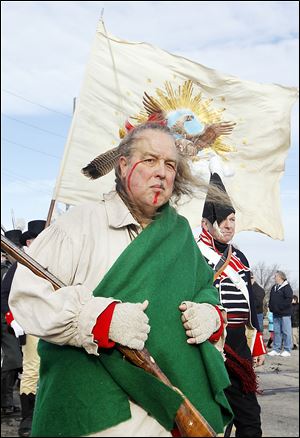
Rusty Cottrel of Springfield, Ohio, who is part Shawnee, dresses as a Peckuwe Shawnee Native American.
The general is said to have jumped out a window, mounted the horse, and “galloped away to the sound of the guns,” Mr. Naveaux said. Re-enactors on Saturday were to retrace the general’s route from what is now the Sawyer Homestead on East Front Street to the battlefield.
The second Battle of the River Raisin was a major U.S. defeat. The next day, Indians returned and massacred the wounded. Only 33 of 934 soldiers from Michigan, Ohio, and Kentucky escaped death or capture. From the defeat came the rallying cry “Remember the Raisin.”
The National Park Service operates the River Raisin National Battlefield, where some events were to take place. The service offers a special stamp visitors can collect on its “passport” books to mark the bicentennial.
Blade staff writer Vanessa McCray contributed to this story.
Contact Mike Sigov at: sigov@theblade.com or 419-724-6089.